
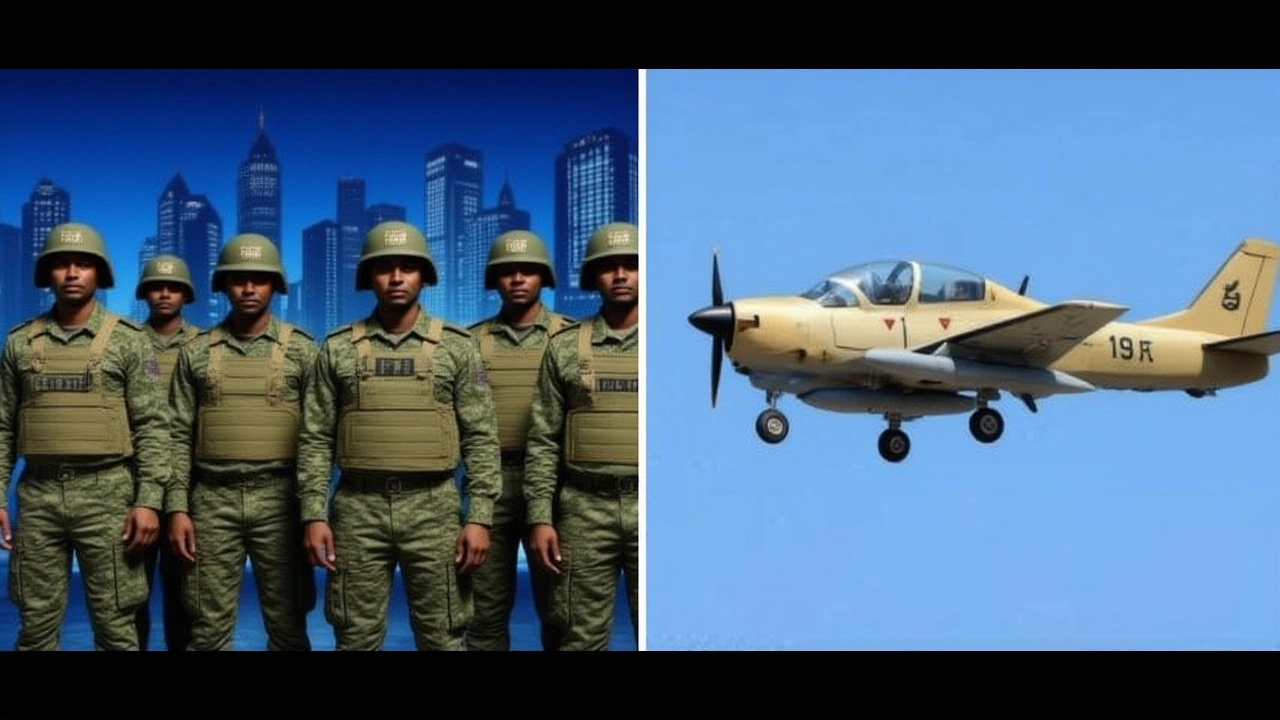
On December 7, 2025, Benin’s democracy teetered on the edge when Lieutenant Colonel Pascal Tigri, a decorated but disgruntled officer, seized state television and declared the overthrow of President Patrice Talon. Within hours, Nigerian fighter jets roared over Cotonou, dropping precision strikes on Camp Togbin—the epicenter of the rebellion—and ground troops crossed the border to secure key sites. The coup, which began with armored vehicles barreling down Boulevard de la Marina and helicopters circling the Presidential Palace, collapsed before sunset. How? Because Nigeria didn’t wait for diplomacy. It acted.
How a Disgruntled Officer Nearly Toppled a Democracy
Pascal Tigri wasn’t some rogue recruit. He’d commanded the Special Forces group of Benin’s National Guard after rising through the ranks, and he’d fought jihadists in the north. His men knew how to fight. They knew how to move. On the morning of December 7, they moved on the heart of Benin’s government: Talon’s residence, the National Assembly, and the homes of top generals. Videos showed soldiers hauling machine guns into the courtyard of the state broadcaster. One civilian died in the crossfire. The coup was real. And it was brutal. But Tigri made one fatal mistake: he assumed Benin’s neighbors would stand by. He didn’t account for Nigeria’s red line.Nigeria’s Lightning Response
President Patrice Talon made two urgent calls to President Bola Ahmed Tinubu. The first came as the coup announcement aired. The second, 27 minutes later, when Tigri’s forces blocked access to the capital’s main radio tower. Within 90 minutes, Nigerian Air Force Nigerian Air Force jets were in Beninese airspace. For 30 minutes, they struck Camp Togbin—destroying weapons caches, silencing rebel communications, and cratering armored vehicles parked near the command center. At least seven putschists were confirmed dead. Nigerian ground troops, armored and silent, rolled in shortly after, securing the Presidential Palace and neutralizing remaining resistance. This was Nigeria’s first foreign military intervention since 2017, when it helped restore Adama Barrow in The Gambia. But this time, the stakes were higher. Benin’s democracy—35 years old, fragile, and increasingly strained by corruption and economic stagnation—was on the line.France, Ivory Coast, and ECOWAS Join the Fray
What made the intervention even more remarkable was the speed of regional coordination. French Air Force aircraft were spotted circling above Kadanu, not engaging directly, but providing surveillance and intelligence. Their presence signaled Paris’s quiet but firm backing of constitutional order. Meanwhile, Ivorian soldiers arrived in Cotonou by dawn, securing checkpoints and detaining suspected coup sympathizers. ECOWAS didn’t just issue a statement. It activated its Standby Forces within six hours. By midday, patrols were visible along the Benin-Nigeria border. The bloc’s condemnation wasn’t hollow—it was operational. “This is not about supporting one leader,” said an ECOWAS official speaking anonymously. “It’s about stopping the domino effect.”Why This Matters Beyond Benin’s Borders
Benin’s elections were scheduled for April 2025. President Talon, in power since 2016, was constitutionally barred from running again. But his administration had spent years weakening judicial independence and silencing critics. Many saw him as an autocrat in democratic clothing. Yet even critics of Talon agreed: a military coup would have been catastrophic. The coup attempt exposed a dangerous trend: soldiers in West Africa are no longer just responding to insurgencies—they’re turning their weapons inward. In Mali, Burkina Faso, Niger, and now Benin, military officers have seized power or tried to. Tigri’s group had combat experience. They had weapons. They had a plan. What they didn’t have was time. Nigeria’s swift response sent a message: regional stability still matters. Even if democracy at home is imperfect, the cost of letting a coup succeed is too high. “We’re not here to defend Talon,” said General Olui Oluyodig, Nigeria’s Chief of Defense Staff. “We’re here to defend the principle that power must pass through ballots, not bullets.”What Comes Next?
Tigri remains at large. Authorities say he fled toward the Togo border, possibly with a small group of loyalists. The Benin government has launched a sweeping purge of the military, arresting over 40 officers linked to the plot. Talon has promised reforms—but skeptics wonder if this is just another power grab disguised as reform. ECOWAS has pledged to monitor the electoral process leading up to April 2025. The U.S. and EU have suspended non-humanitarian aid pending judicial reforms. Meanwhile, Nigeria has quietly increased its military presence along the Benin border, citing “ongoing security concerns.” The real test won’t be whether Talon survives. It’ll be whether Benin’s institutions survive him.Frequently Asked Questions
Why did Nigeria intervene so quickly in Benin?
Nigeria has a vested interest in regional stability. A successful coup in Benin could inspire similar attempts in Nigeria’s own volatile south and destabilize the entire West African bloc. Nigeria’s military has trained with Benin’s forces for years—they know their tactics. Allowing Tigri to succeed would have signaled that coups pay off. Nigeria acted to shut that door before it opened.
Was this intervention legal under international law?
Yes. Nigeria acted at the formal request of Benin’s constitutional government, which meets the criteria for lawful intervention under the UN Charter and ECOWAS protocols. Unlike past coups where foreign powers intervened unilaterally, this was a requested defense of a sitting president against armed rebels. The involvement of France and Ivory Coast further legitimized the operation as a multilateral effort.
How did French forces contribute without firing a shot?
France provided critical intelligence, surveillance, and airspace coordination. Their aircraft tracked rebel movements in real time and relayed data to Nigerian jets. French military advisors on the ground helped identify key targets at Camp Togbin. Their role was force multiplier—not combatant. This mirrors France’s strategy in other former colonies: backing local efforts without direct involvement.
What does this mean for Benin’s upcoming April 2025 elections?
The coup attempt has intensified scrutiny on Benin’s electoral integrity. While Talon’s government claims victory, opposition leaders fear a crackdown. ECOWAS has deployed 150 observers and pledged to certify the vote. But with over 40 military officers detained and state media under new control, trust in the process remains low. The real question: Can Benin hold free elections if the military still holds the keys to power?
Why did the coup fail so quickly?
Tigri miscalculated. He assumed the Nigerian military would hesitate, like in past coups. He didn’t count on Tinubu’s zero-tolerance policy or the fact that Benin’s military leadership remained loyal. The strikes on Camp Togbin decapitated command. Within hours, rebel units lost communication. Without leadership, coordination, and air cover, their weapons became useless.
Is Nigeria’s intervention a double standard, given its own democratic challenges?
It’s a fair criticism. Nigeria faces its own protests, election disputes, and military unrest. But this wasn’t about Nigeria’s domestic politics—it was about preventing a regional contagion. The international community rarely punishes coups as swiftly as it did here. Nigeria chose principle over hypocrisy: even imperfect democracies deserve protection from violent overthrow. The world noticed.



Comments
Anthony Watkins
This is wild. Nigeria just dropped bombs on a neighboring country and everyone’s acting like it’s a superhero movie? What’s next, sending drones to Canada for jaywalking? 🤡
Jane Roams Free
It’s actually kind of impressive how fast they moved. Even if Talon’s sketchy, letting a coup succeed would’ve opened a can of worms across West Africa. Sometimes you gotta stop the fire before you argue about who started it.
Also, props to ECOWAS for actually doing something instead of just tweeting.
Christine Dick
Oh, so now Nigeria is the global moral police? Let me guess-Tinubu’s got a pristine human rights record, right? The same country where protesters get shot in the streets, where elections are rigged, where police extort citizens daily? This isn’t about democracy-it’s about power, and you’re all just cheering for the guy with the bigger gun.
Crystal Zárifa
It’s funny how we cheer when the big guy stomps on the bully… until we realize the big guy’s just a different kind of bully.
Still, I’ll give them this: they moved faster than my WiFi when I’m trying to stream.
Serena May
They’re lying. The jets were fake. CGI. Nigeria doesn’t even have that kind of tech. This is all a psyop to distract from their fuel shortages. 👁️👄👁️
Danny Johnson
Man, I don’t know much about African politics, but I know this: if someone tries to overthrow a government and gets crushed in hours, that’s a good sign someone’s got their shit together.
Hope the people of Benin can breathe easy now.
Bryan Kam
Wow. Nigeria intervened. How… quaint.
James Otundo
Oh, so now the West African ‘democracy’ club gets to decide who gets to rule? Please. This is neocolonialism with a new logo. France, Nigeria, Ivory Coast-same old puppet show. Talon’s just their favorite puppet now.
Jason Davis
Let’s be real-this is the first time in a decade that a coup attempt got shut down before it became a Netflix docuseries. Nigeria didn’t wait for a UN vote or a press release. They showed up with boots and bombs and said ‘nope.’
Yeah, Talon’s flawed. Yeah, Nigeria’s messy. But if you let one coup slide, you get ten. And then you get a region where the only law is the barrel of a gun.
Jullien Marie Plantinos
So Nigeria’s the hero because they bombed a guy who tried to take power? What if he was trying to fix corruption? What if Talon was the real villain? You people are so quick to cheer violence when it’s the ‘right’ side. Pathetic.
Cheri Gray
i think this is so cool like nigerias like the big bro who says no more drama but also like… is it really democracy if you just let the same guy stay in charge? idk man i just hope everyone gets to vote in april 😅
Cheryl Jonah
Wait… what if the whole thing was staged? What if Talon paid Nigeria to fake a coup so he could crack down on dissent? What if the ‘rebel’ soldiers were actors? The military’s been training with Nigeria for years-maybe they just did a drill… and called it a coup. 🤔
Andrea Hierman
While the moral complexity of this situation cannot be understated-particularly given the longstanding issues of governance and democratic backsliding in Benin-it is nevertheless remarkable that a regional coalition, operating under the framework of ECOWAS protocols and at the explicit request of a constitutionally legitimate government, was able to neutralize an armed insurrection within a single day.
This stands in stark contrast to the historical norm of prolonged instability, foreign interference, and impunity. The speed and precision of the operation suggest not only operational readiness, but a collective will to preserve institutional continuity over personal ambition.
Whether this precedent will be applied consistently, or merely selectively, remains to be seen. But for now, it is worth acknowledging: sometimes, the most democratic act is not waiting for consensus-but preventing chaos before it becomes irreversible.